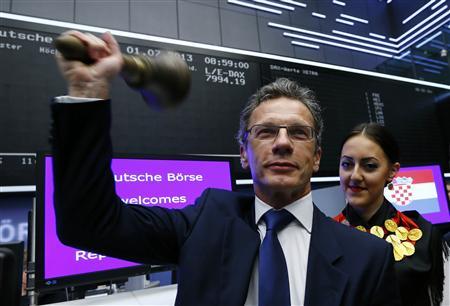
Despite recent steps to improve the business environment, much more was needed in Croatia to ignite growth after five years of recession, including a growth model based on exports and investments, Vujcic said.
Read source article here


Despite recent steps to improve the business environment, much more was needed in Croatia to ignite growth after five years of recession, including a growth model based on exports and investments, Vujcic said.
Read source article here

Exciting, but challenging times at BBD. The engineers have done their lot, now the deal folks have to step up – as they have in the past. The company needs to rebound – recapture the energy, drive and vision it exhibited in the late 90s. It’s a different playing field, with stronger competitors – but it can always be done.
Read source article here
CSeries sales are at 177 firm orders, far short of Bombardier’s goal of 300 by the time the plane enters service next year…Bombardier, which also makes trains, is staking a claim in a niche: the single-aisle, 100- to 149-seat class that is midway between the size of so-called “regional” planes and the larger commercial jetliners of Boeing and Airbus. Bombardier says it can corner half that market over the next 20 years.

This year, 16 of 24 finalists of Google Inc. (GOOG)’s annual Code Jam programming competition were from central and eastern Europe. The region also accounted for 8 of 13 winners at this year’s ACM International Collegiate Programming Contest sponsored by International Business Machines Corp.
Read source article here.

“Air France is behind its competitors in terms of restructuring, that’s why they need further measures,” said Yan Derocles, an analyst at Oddo Securities in Paris. “While the most recent results started showing the fruits of some of their initial moves on short-medium haul traffic, Air France is still one or two years behind the competition.”
Read source article here.
“Military asset securitization, or tapping capital markets for military expansion, will be the future trend and the funding scale will also become bigger and bigger. Now aviation and weaponry may also be the next sectors for asset securitization.”
Read source article here.

One big job: handling the difficult integration of Hewlett-Packard’s $13.9 billion purchase of Plano, Texas-based Electronic Data Systems Corp. in 2008, which involved absorbing 135,000 people…˝Marius basically lived in Plano for six months and helped people get through the emotional difficulties,” Robison said. As part of the process, Haas kept detailed tabs on people, finances and operations, Robison said. “I don’t know how he kept track of it all — maybe he kept notebooks.”
Read source article here.
You ignore cultural differences in negotiations at your own peril. I have seen seemingly innocuous lapses in cultural understanding from our perspective cost clients millions of dollars, One would think this only happened with cultures far different from our own, but that is not always the case. I recall a negotiation for a Canadian company with Norwegian/Swedish counterparts – some misplaced bravado on the part of one of the Canadian team-members cost the company over $20 million. It was just a little more exuberance than the Scandinavians found in good taste – so extracted a punishment.
Read source article here.
Another major difference … was that Americans tended to exchange information more openly with each other, trying to make clear their needs… This may be due to differing levels of trust in negotiations in dignity versus honor cultures, says Aslani. “There is a notion in Western culture called swift trust: when first interacting, people trust each other, unless their counterpart proves to be untrustworthy,” he explains. “In Middle Eastern culture, trust is a commodity you have to earn through repeated social interactions. So when interacting for the first time, usually the Middle Easterner’s assumption is ‘I’d better not trust you too much, until you prove yourself trustworthy.’”
The researchers also found that the Qataris were more likely than the Americans to use emotional tactics—such as showing anger, frustration, or sympathy—to influence the outcome of the negotiation. “People in honor cultures have strong norms for hospitality and warmth, but in a competitive situation like negotiations, in which their self-worth could be threatened, they are more inclined to get emotional and use aggressive negotiation tactics than Americans,” Aslani explains.
When commodity prices are sky-high and money is cheap and plentiful, economic growth is almost inevitable. In Latin America over the last decade, countries with sound macroeconomic policy frameworks, like Colombia, Peru, and Chile, grew rapidly. But so did Argentina, a country whose government seems to start every day wondering what more it can do to weaken economic institutions and damage long-term growth prospects.
Read source article here.
There is nothing wrong with exporting copper, wine, fruit, and forest products. But economic history suggests that countries seldom – if ever – get rich by doing just that. Commodity-rich advanced economies like Canada, Norway, or Australia export lots of natural resources, of course, but they also export many other goods and services. That is not true of Chile, Peru, or Colombia – or even of Brazil, with its much larger population and more developed industrial base.
There is also nothing wrong with exporting services through tourism, but countries seldom get rich – or experience broad-based long-term growth – by doing just that.
“The inventor’s tacit knowledge is important because it can overcome the competitive advantages in technology implementation that existing firms derive from complementary assets,” Spulber writes. That is, the difficulty of transferring tacit knowledge puts the existing firm at a disadvantage, and however effective the transfer, existing firms cannot possibly know as much as the inventors about their inventions.
Read source article here.
The risk that companies are saved for strategic reasons, either by a takeover or a buyout, has been rising as concerns about the health of the economy ebb, interest rates start to rise and companies look for acquisitions to fuel growth.
Read source article here.